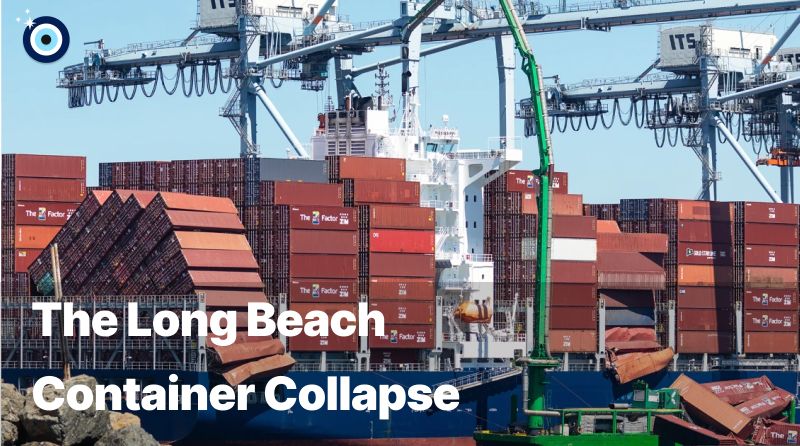
Collapsing rows. Falling containers. Smashed barges.
* The Long Beach Container Collapse: What 75 Falling Containers Teach Us About Communication.
On the ninth of September last year, at a berth in the Port of Long Beach, around seventy-five containers came off the ‘Mississippi’ while she was being offloaded. Two rows collapsed. The ship listed. Containers tumbled into the water, and many crashed onto a small barge alongside.
A worker on that barge sprained his ankle running to get clear. That was the worst human injury of the day. Officials called it a miracle, and it certainly seems hard to disagree.
Earlier this year, the Maritime Executive wrote, “the investigations’ preliminary findings indicated that there were no established policies or planning tools in place to account for vessels alongside during cargo operations. It says that the reliance on ad-hoc communications protocols has been identified as a contributing factor.”
The incident remains under investigation, so I am not going to sit in judgement. But the incident raises a question I think every terminal must grapple with, whatever the final report might conclude.
In that moment, a lot of people needed to know something, fast. The crews offloading. The worker on the barge. The crane operator. The teams nearby. When a stack lets go, the difference between a damaged barge and a funeral can come down to how quickly the right information reaches the right person.
That is what a compressed, multi-party yard really comes down to. Safety does not only depend on the lashing, or the crane, or the plan. It depends on communication:
- Does a hazard spotted by one team reach the others in seconds, or in a shift-handover note?
- When something starts to look wrong, who hears about it, and how fast?
- Are the people closest to the danger the first to know, or the last?
None of this is a comment on the workers at Long Beach- in a moment like that, people act fast, on the information they have. The real question is whether the system around them puts the right information in their hands in time, or leaves them to find out the hard way.
That is a large part of what we are trying to do with Qavach. To move safety-critical information, the hazard, the near-miss, the rising risk, to the people who need it - while it can still change the outcome, not after the report is written.
They were lucky at Pier G, but luck is not a safety system.
When something starts to go wrong on your terminal, how do you ensure the right people find out- fast?


