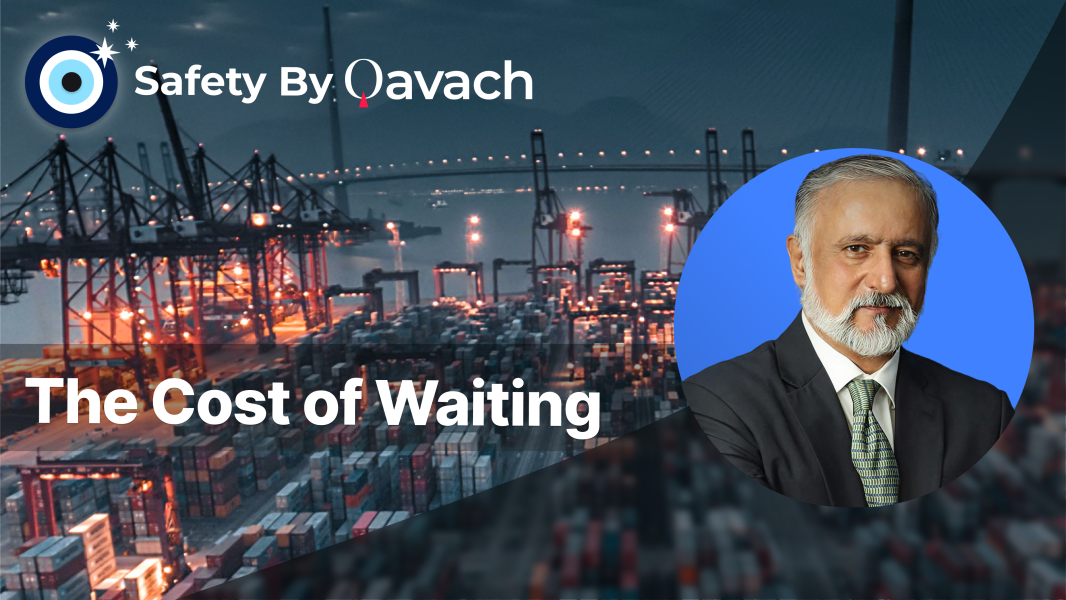
Budget season brings every priority to the table. But when it comes to safety, are we looking at the cost of investing — or the cost of waiting?
In container terminals, safety often receives the resources it needs only after an incident has made the consequences impossible to ignore.
This week’s Safety Insights explores the cost of overlooking risk, the two safety budgets every CEO has, and why a quiet dashboard doesn’t always mean a safe operation.
The real question is not whether we can afford to invest in safety. It is whether we can afford to wait.
Read this week’s newsletter for my thoughts on making safety a priority before circumstances make that decision for us.
Budget season brings us to big numbers, hard calls, and pitches- but mostly, it brings us back to our priorities. There is only so much to go around, and every department has a case to make for its share.
I invariably see that safety has to fight harder than it should for that share. We are quite comfortable debating the cost of safety, but how often do we put the cost of overlooking a risk on that same discussion table?
An incident can change that conversation very quickly- suddenly, the resources that were difficult to find are no longer in question. But by then, we may have already paid a far greater price.
I think we need to get better at making the case for safety before we are forced to. That means understanding where our risks lie, where investment can make the greatest difference, and whether the information we have is giving us the full picture.
A few thoughts this week on budgets, priorities and the cost of waiting.
Till next time, Arjun
I have found, all too often and to my continued despair, that safety is seen merely as a cost to control. With lives at stake in a container terminal– and bottom lines directly impacted– surely, we must pause to consider what is the cost of overlooking a risk?
With stretched HSE teams and manual processes, prevention is made difficult by the resulting delayed reporting and hidden hazards. Investing in better safety management is not just about compliance and ticking boxes. It is about putting resources where they can make the greatest difference.
We built Qavach .AI to help container terminals turn safety data into actionable intelligence, support incident reporting, root-cause analysis and corrective actions.
But technology alone is not the silver bullet. This is also about prioritising smartly, allocating resources wisely and ensuring that critical risks are not overlooked.
I continue to work for terminal leaders taking a more informed approach to safety investment.
For starters, explore the potential value through our Pain Point Register and ROI calculator. See how Qavach .AI can help your terminal make safety a measurable priority. Request a demo.
👉🏼 Read more on LinkedIn
The need for prioritisation brings me to a simple idea I like to revisit– the 2 Jar Theory
Consciously or unaware, every CEO has two jars.
One labelled “Safety Budget.” The other– “Safety Budget After an Accident.”
The first stays light and airy. The second overflows, which means this jar is for when it’s too late.
I’ve seen this pattern too often in our industry. When it comes to safety, we are reactive, we tend to invest more after an incident, when the cost of waiting has already become painfully clear.
But the cost of waiting goes beyond the budget implications. Too many risks remain hidden in missed reports, overlooked warning signs and dashboards that show activity without revealing the full picture.
▶️ Watch on YouTube
Sometimes the most worrying signal is not what the dashboard shows, but what it fails to show. That is when a quiet dashboard deserves a closer look.
What if your safety system misses the turbulence? No near misses. No unsafe acts. No noise. Just silence.
When the dashboard is too quiet, it could mean it’s time to worry. It can mean risks are going unreported and warning signs are being missed.
Low incident numbers may look good, but they don’t always tell the full story. Sometimes, silence comes from hesitation, reporting friction or fatigue.
The strongest safety cultures aren’t built on clean reports. They’re built on open reporting, visible risks and timely corrective action.
That requires making safety reporting near-effortless. With MyQavach, workers can use mobile reporting, voice-to-text and image uploads to capture what they see directly from the frontline. Less friction in reporting. Better visibility into risk. More opportunity to act before an incident occurs.
I always advise, safety isn’t about keeping the dashboard quiet. It’s about ensuring the right warning signs are heard, recorded and acted upon.
👉🏼 Read more on LinkedIn


