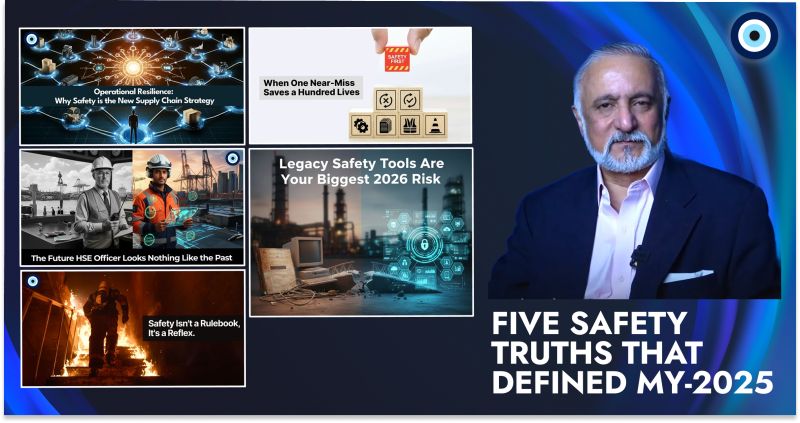
As 2026 has got going, I’ve been looking back at the conversations that defined last year.
Not trends. Not forecasts. I see patterns.
Five of my pieces from 2025 stood out because they kept resurfacing- in terminal visits, boardrooms, and budget discussions. Each one captured a friction point that operators and safety leaders live with daily.
1️⃣ Who Really Decides Safety Transformation?
One post in October stayed with me. It wasn’t about technology, but gatekeepers. So many safety initiatives didn’t fail from a lack of vision. They stopped at procurement desks where ROI on disaster prevention wasn’t really understood. Until safety can be discussed in the language of value- not just compliance- progress remains slow and conditional.
Link: https://lnkd.in/gkeHGs7S
2️⃣ Legacy Safety Tools Are Your Biggest 2026
This came from analyzing what happens when organizations run dozens of disconnected EHS applications while regulators demand real-time data. Fragmentation doesn’t just create inefficiency- it creates gaps. And gaps are where things get missed. "One cannot manage modern risk with tools designed for a different era."
Link: https://lnkd.in/gKFJBAEi
3️⃣ The Future HSE Officer Looks Nothing Like the Past
Conversations with CEOs revealed a struggle to find HSE leaders who combine safety expertise with data fluency. The old model - decades of dock experience - no longer guarantees success. Today's HSE leaders need to transform safety from cost center to value driver, and that requires different capabilities entirely.
Link: https://lnkd.in/gGiHJ3Ad
4️⃣ The Near-Miss Cascade: What Happens After Reporting?
Near-miss reporting has improved across the industry. What hasn’t kept pace is follow-through. True safety isn't capture - it's orchestrating response across the organization. That gap is still one of the most underestimated risks I see.
Link: https://lnkd.in/gkRiT_Qq
5️⃣ Operational Resilience ≠ Crisis Recovery
Written after watching terminals confuse bouncing back with never going down. Real resilience means anticipating disruption, mapping interdependence, mobilizing before impact. The companies still thriving in 2026 won't be those who recover fastest, but those who never needed to.
Link: https://lnkd.in/gR4VC-Ej
These aren't just theoretical observations. They come from realities of friction. These realities continue to shape how we think about safety, systems, and leadership at Qavach.
💡 As you look ahead to a new year, which of these still feels unresolved in your operation?
Because if last year showed us anything, it’s that ignored friction doesn’t disappear. It compounds.