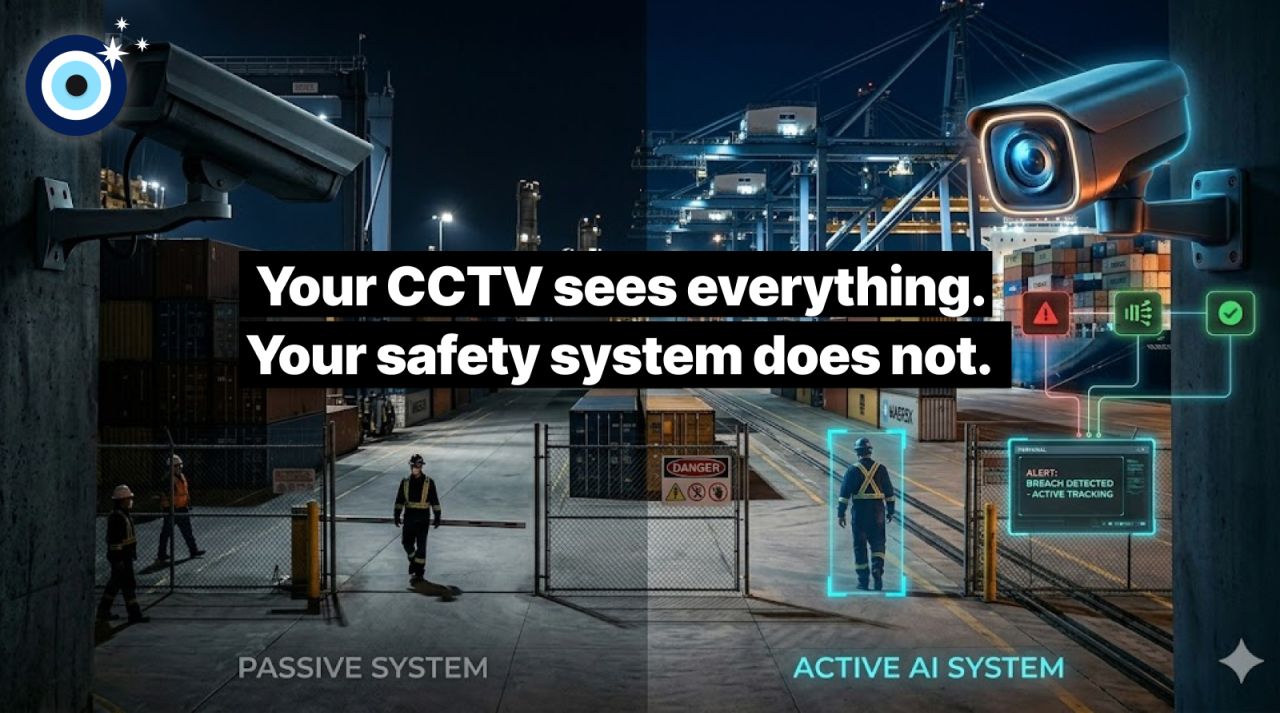
What is your CCTV doing right now — beyond recording? How does it contribute to safety ?
That is the problem all terminal operators are living with in 2026.
Good data-driven safety was a genuine leap forward — like Qavach. Feed your incident reports into a system, get a root-cause, automated CAPA, multiple dashboards and reports, track your TRIR and LTIFR. You get visibility. You get history. You get workflows. You get alerts. You get a very detailed picture of everything that went wrong and what to do to fix it.
But a camera watching a worker step into a restricted zone doesn't file a report. It records. It timestamps. And then — as in most terminals — it does absolutely nothing. No alert. No warning. No action triggered.
Autonomous safety changes that equation completely.
Qavach.AI doesn't wait for someone to log an incident. It reads the yard. Video feeds, proximity sensors, visual cues from equipment movement and worker behaviour — scanned, interpreted, and a complete safety incident processed and documented in under 15 seconds. Cross-referenced against your full incident history, and acted upon before the hazard becomes a statistic.
The difference is not more data. It is data that thinks — and that comes from Autonomous Terminal Safety Intelligence.
A data-driven system tells your QHSE Manager what happened on Bay 7 at 14:23 on Tuesday. An autonomous system tells your operations team what is about to happen — and triggers the intervention.
For terminal operators managing high-density yards, night shifts, and contractor workforces, this is not a software upgrade. It is a fundamentally different relationship between intelligence and action.
Data-driven safety is reactive with a better memory.
Autonomous safety is a system that never stops watching, never stops learning, and never waits to be asked.
The yards that will lead on safety in this decade aren't the ones with the most data.
They're the ones whose data has learned to act.
QavachAI Built for terminals. Deployed in 42 days.