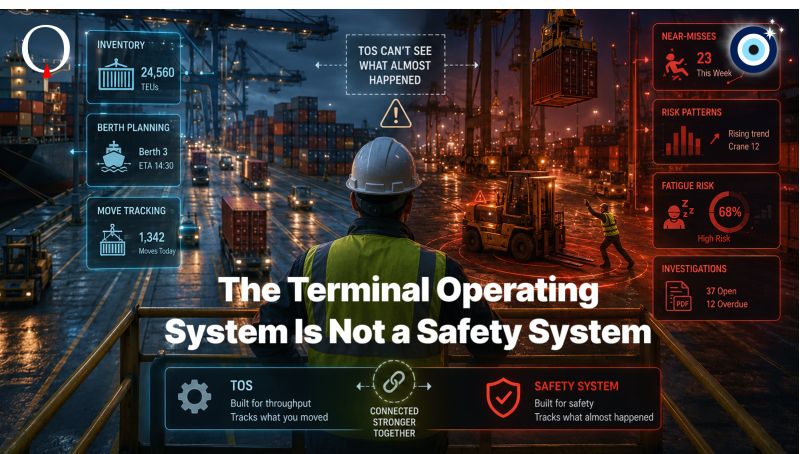
The Terminal Operating System Is Not a Safety System
Your TOS is not a safety system. Stop expecting it to be.
A throughput tool can't do a risk tool's job.
Most terminals I've worked with have stretched their Terminal Operating System far beyond what it was built for.
- Inventory? Yes.
- Berth planning? Yes.
- Move tracking? Yes.
- Safety risk management? Somehow, also yes.
I've spent 20+ years watching this confusion play out.
A TOS is built to optimise throughput. To move boxes faster. To plan operations efficiently.
A safety system is built to detect, predict, and prevent risk. Two very different jobs. Two very different data models.
The brutal reality of what happens when one tool is asked to do both:
→ Safety becomes a module, not a function
→ Reporting becomes a checkbox, not an insight
→ Near-misses get logged in fields no one looks at
→ Risk patterns get buried inside operational data
→ Investigations live in PDFs detached from the actual system
A TOS can tell you a container moved.
It can't tell you why a worker almost got hurt while moving it.
It can't predict that the same crane has triggered three near-misses in two weeks.
It can't connect a shift change pattern to a rising fatigue risk.
Because that's not what it was built to do.
I've seen this single confusion silently hurt the industry for years. We've sold safety short by treating it as a feature of an operations tool, instead of a system in its own right.
At Qavach, we built a safety platform — not a TOS module.
It connects to your TOS. It enriches your TOS. But it does the job your TOS can't.
Because your operations system tracks what you moved.
Your safety system should track what almost happened.
Two different jobs. Two different tools.
When was the last time your TOS surfaced a risk you didn't already know about?