As I get ready for the Container Terminal Automation Conference where I present on our Autonomous Terminal Safety Intelligence software, I reflected on some of my research.
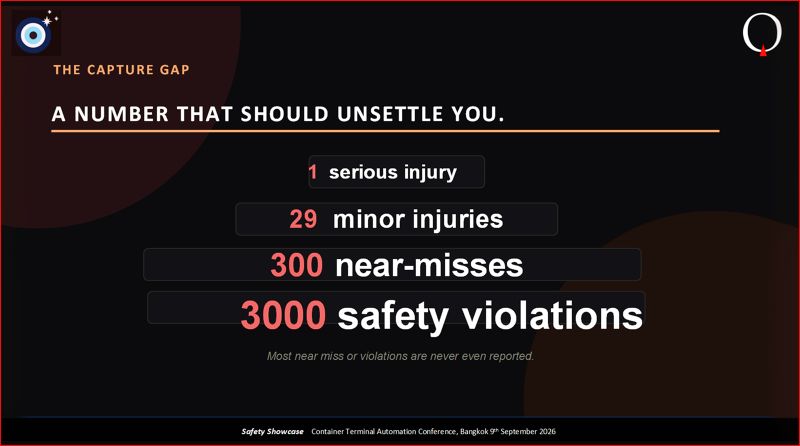
A quick search just by typing 1 : 29 : 300 : 3000 will give you something to give pause, and give caution.
Wikipedia reports “ The foundational 1:29:300 ratio was first proposed by Herbert William Heinrich in his 1931 book Industrial Accident Prevention: A Scientific Approach after studying thousands of industrial accident reports. Later safety professionals and training programs expanded Heinrich's original three tiers by adding 3,000 unsafe acts or conditions at the absolute base of the pyramid to emphasize how daily habits cause larger accidents” https://lnkd.in/gyDNRPi8
This study has been repeated over time, and in spite of improved procedures and practices, better software and now AI, the shape of the pyramid remains largely unchallenged.
And the most frightening aspect of it all, are Near Misses.
Most studies, and data on file show that they are grossly under observed, under reported, and under actioned in CAPA. This “Capture Gap” as I call it, is a symptom of terminals working primarily on trailing indicators, as opposed to leading indicators, which would take inference from evolving risk, and take preventive steps.
A near miss is a certain incident in waiting for the right conditions, which will come – sooner than later. Near misses are an early warning of threat to man, machinery and the environment, and if it is not being reported, then the cancer is building as is the risk.
But, what if Computer Vision, as in our ATSI, is active all across the terminal? Then, you are leading, viewing through the windshield, and taking early preventive action.
If I were to give the terminal leadership one reason to have a purpose built QHSE software like the Qavach I’d say it is to be pro-active and eliminate the unseen threat.
I also found a meaningful page on a website on Near Miss that I believe is good reading. https://lnkd.in/gwrCCree


