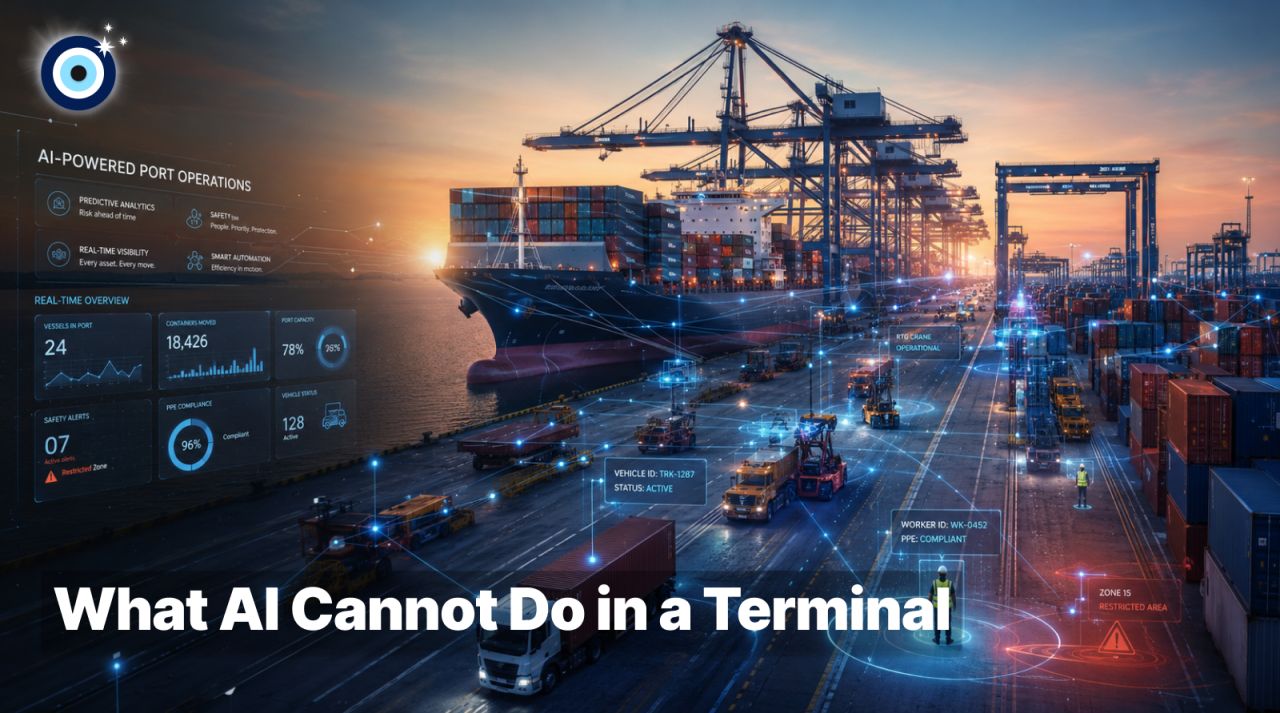
Most of the AI conversation in our industry right now runs in one direction. More detection. More prediction. More automation, fewer people in the loop.
I find, though, that the more useful question is, “What should a system in a terminal never be allowed to do on its own?”
A tool that claims no limits is not more capable. It is likely less honest. And on a terminal, where a wrong call is measured in people, honesty matters.
So- not a limitation, a design choice.
Here is where we drew the line, on purpose:
• The system can flag that a worker has stepped into a restricted zone. It remains a human call whether to halt the whole operation in response.
• It can tell you a stack is behaving unusually. A human’s judgement decides whether to send someone up to check.
• It can rank today’s risks, in order. But it doesn’t get to decide which risk your shift can live with.
None of these are gaps we are racing to close. They are boundaries we built in. The machine does the brute work- the relentless watching, the counting, the pattern across a thousand incidents that no person can hold in their head. What it should not carry is judgement that has very real human consequences.
This boundary is a cornerstone of how we built Qavach. It does the tireless part extremely well, and hands humans the calls that should stay human– to make them with better information than they’ve ever had.
A system that is clear about where it stops, can be trusted a good deal more than one that claims it never does.
So the question is not how much your system could do on its own.
It is how much you would actually want it to.


