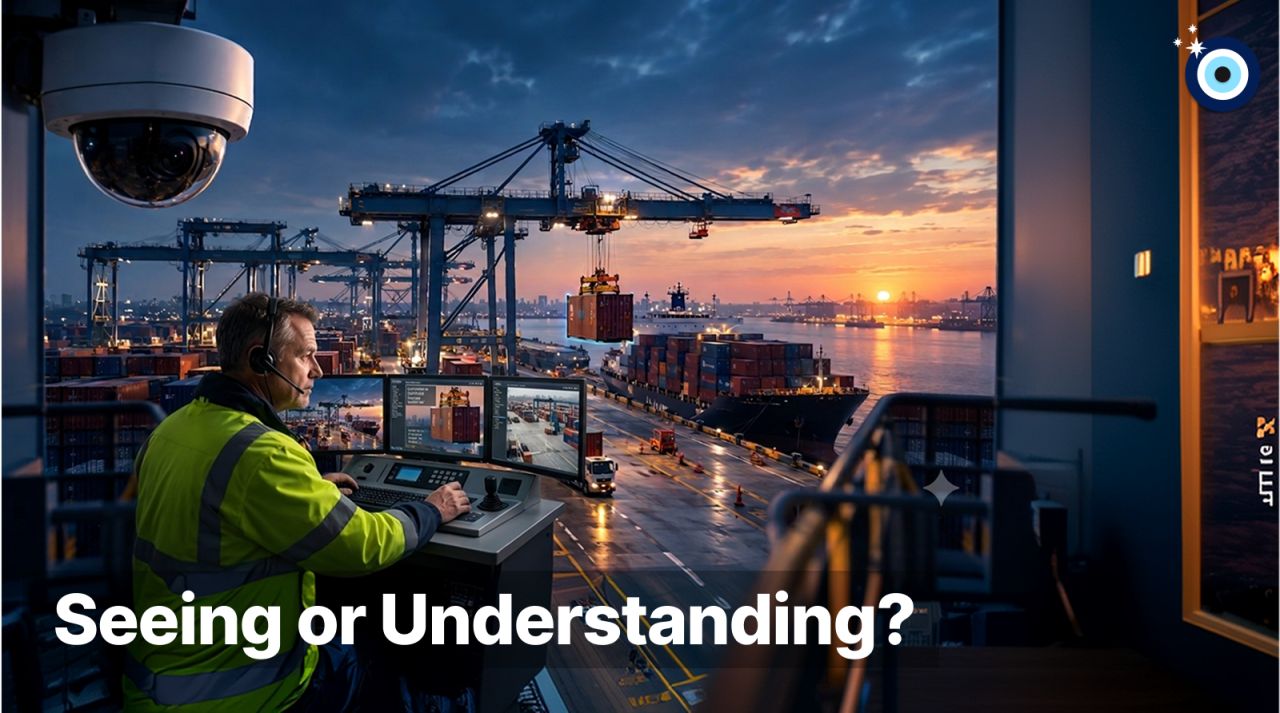
A camera registers an object. Then goes back to being oblivious.
Every terminal already has cameras. Dozens of them. They see everything, record a lot, and understand very little.
A camera can tell you a container is there. It cannot tell you the container is swinging a little too fast, over a lane a worker walking below, on a crane that logged two near-misses this week.
Seeing is the easy part. But our job is to deal with consequence- both real and potential.
This is where I think the lines can be blurry. A lot of what gets sold as ‘intelligent’ is really just very confident detection.
It reports activity. It does not interpret risk.
It can tell you what is in the frame, not what the frame means.
When we were building, this distinction mattered most to us.
• Detection notices an object. Understanding notices a hazard forming.
• Detection logs an event. Understanding connects it to other events across a period of time.
• Detection shows you what happened. Understanding tells you what is about to.
We did not want to build another system that watches. There are enough of those, and they have not made terminals meaningfully safer. We wanted one that reads a scene the way an experienced supervisor does, for consequence, not just for contents.
That difference, that distinction is what we have built Qavach around. A system that understands what it is looking at, cross-references it against everything it has seen, and acts while the outcome can still change.
Your cameras have been seeing everything for years. Is it time for the understanding to level up?


