Ask a sailor where things can go wrong. Often, they’ll say it’s the moment one person hands over to the next.
Anyone who has spent time at sea knows the watch handover. One person has held responsibility for hours, reading the conditions, holding the whole picture in their head. Then they pass the baton to the next man. It takes a few minutes, a few words, before they walk away for a well-deserved break.
It is the most ordinary of moments on a ship. It is also one of the most exposed. A great deal must pass from one mind to another, quickly, and whatever does not pass across… simply disappears into the dark night.
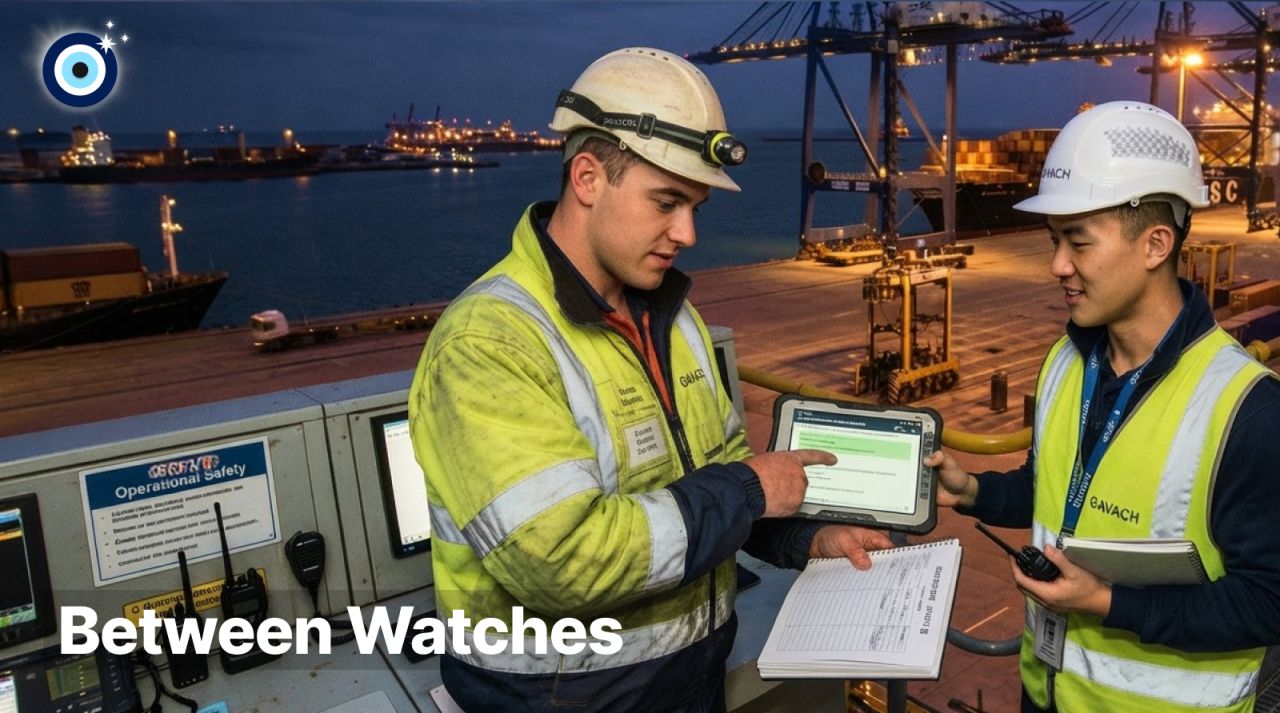
A container terminal is stitched with the same thread, we just call it a shift change. And I find we tend to treat it as a formality, rather than the risk point it actually is:
• A near-miss noticed at 0436 can becomes an indelible story by 0454.
• One shift saw something build, evolve, transpire… this may not be logged at watch handover.
• The context, the understanding, the meaning lives in one person’s head… then that person simply goes home.
The handover is where knowledge is most likely to fall through, almost because it looks like an ordinary, routine moment. It is routine, but deserves way more attention than it usually gets.
Part of what we wanted from Qavach was to stop safety knowledge from depending on whether it survived a handover. What one shift sees, the system can hold. The next shift starts equipped, rather than hoping key information didn’t walk out of the door.
The Qavach works on explicit data. Computer Vision. AI analysis. Automated feeds. Autonomous processing. NO GAPS.
At sea you learn, in time, to respect the handover. On a terminal, we must learn to build that muscle too. And Qavach ensure the risk mitigation


