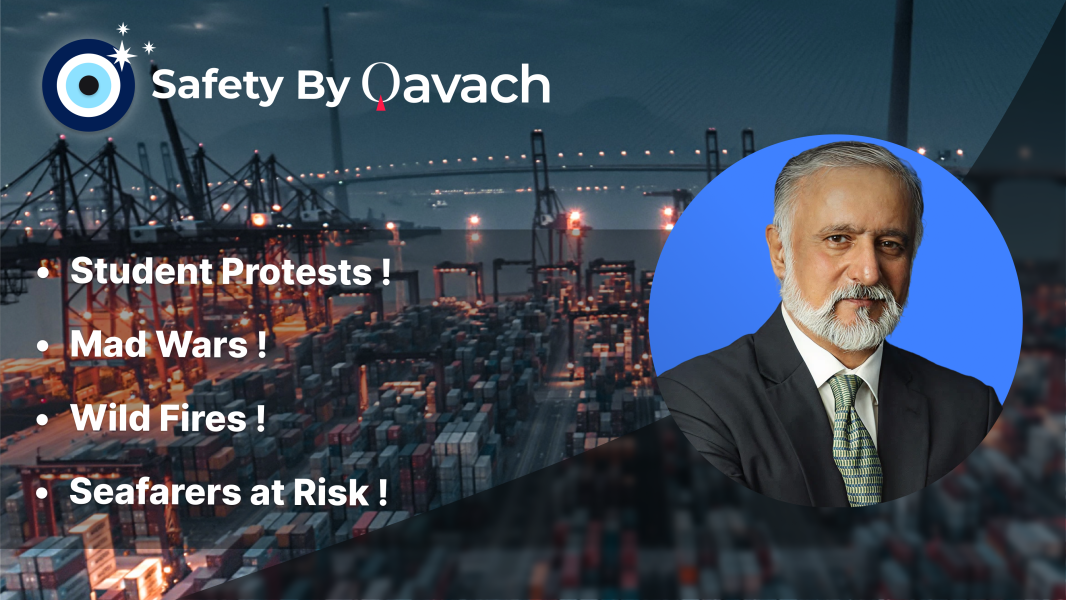
Every week brings headlines that demand our attention. The real question is whether we simply read them—or take the time to understand what they are truly telling us.
In this week's newsletter, I reflect on issues that reach far beyond our industry—from education and global uncertainty to climate change and the growing risks facing the people who keep global trade moving.
I also explore why measuring the right safety metrics and demonstrating the right leadership behaviours are essential to building organisations that don't just perform better, but become truly great.
I hope you find this edition thought-provoking. If you haven't already, I invite you to subscribe and join the conversation.
hashtag#safetybyqavach hashtag#Leadership hashtag#SafetyCulture hashtag#PortsAndTerminals hashtag#futureofsafety
This has been an eventful week with some bold headlines that have significant consequences.
In India one genuinely thought our "Arab Spring" had arrived when masses of young people gathered in New Delhi and them around the country to protest leaked exam papers. While it ended timidly, it highlighted just how deep India's problem is and how desperately education reform is needed to get 100 million under 30 in to a competitive work force.
Sadly, no sanity has arrived in the "War of Choice" and it keeps extending its borders. I am a firm believer that until and unless China steps in and states its claim as the global force, this will keep on and on, and two demented tyrants continue holding the world to ransom.
But the most frightening news is that Europe is the continent heating fastest - already 1.6 degrees Celsius this century alone, and while fires rage and thousands are dying, legislature is loosening environmental regulations and allowing higher pollution. Are they mad ?
Returning to maritime and safety - and the continued plight of seafarers and fatalities at the hands of Iran, United States and now Ukraine is deplorable. Imagine the outrage if passenger airliners were being shot down..............the world would stop in protest.
But get this : No sailors - no ships; no ships - no trade; no trade - THE WORLD STOPS.
We need a moratorium against attacks on ships with strong action - not just calling the Ambassador in for a cup of team and a polite slap on his wrist.
Till next week, Arjun
If you aren’t yet, do consider subscribing to this newsletter so you can share my perspectives regularly. (Use the button up top, or click here)
What separates good organisations from truly great ones?
It isn't technology alone. It isn't processes alone. And it certainly isn't luck.
Revisiting Good to Great by Jim Collins reminded me that enduring success is built on disciplined leadership, the courage to confront reality, a relentless commitment to continuous improvement, and technology that aim to strengthen people, not blindly replace them.
These timeless principles continue to shape our thinking as we build the future of terminal safety with Qavach.AI. Because greatness isn't achieved through a single innovation—it's earned through thousands of better decisions, made consistently, every day.
Those decisions, however, begin with leadership.
👉🏼 Read more about the lessons that resonated with me.
Every board meeting begins with safety numbers. The question is- are they the right ones?
Traditional metrics like TRIR and LTIFR remain valuable, but they only tell us where we've been. The organisations leading the future of safety are shifting their focus towards leading indicators, predictive intelligence and proactive intervention- identifying risks before they become incidents.
Because the best safety metrics help prevent failure, and that's how good organisations continue their journey towards greatness.
👉🏼 Watch my take on YouTube
The strongest safety message comes not from some written policy, but from demonstrable leadership.
Every decision a leader makes on the terminal floor- intervene, challenge, ignore- helps employees believe what the organisation stands for. Over time, these moments define culture far more than any handbook ever could.
When leaders walk the talk, safety becomes a shared belief rather than a compliance exercise. And once the right culture is established, the next question becomes: Are we measuring the behaviours that truly make organisations safer?
👉🏼 I wrote more about walking the talk, here on LinkedIn


