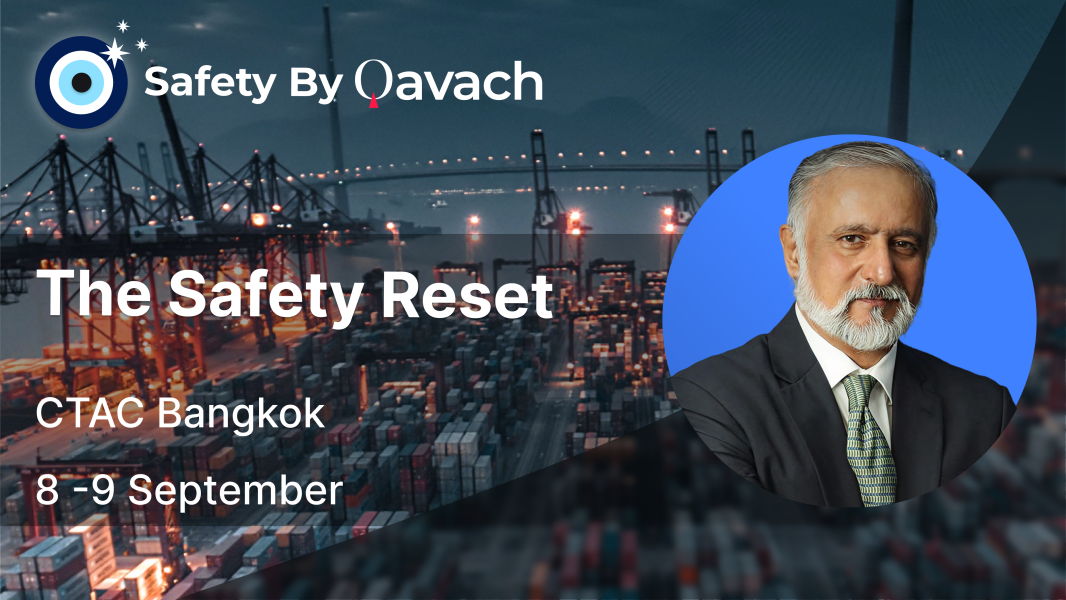
Every industry has moments that redefine its future. I believe container terminal safety is approaching one of those moments.
In this week's newsletter, I explore why we continue to underestimate the true cost of safety failures, why traditional metrics no longer tell the whole story, and how AI is enabling a shift from reactive compliance to predictive operational intelligence.
These are the conversations I look forward to having with industry leaders at CTAC Bangkok.
If these ideas resonate with you, I invite you to read the latest edition and subscribe for future insights.
Every industry has defining moments—moments when the conversation shifts from improving the present to shaping the future. I believe this year's Container Terminal Automation Conference (CTAC) in Bangkok will be one of those moments.
And I think the conversations we need to be having are around how we reset the approach to safety. Too much still revolves around costs of staying safe, ignoring the cost of not being safe enough. I touch upon these themes today as I look ahead to exploring them with many of you in Bangkok next month.
In the coming few weeks ahead of the CTAC, I shall also be writing about amazing work that is being done by the team here at Quantum around AI and Opimisation across multiple processes and operations at your container terminal.
These will also be my areas of presentation at the CTAC in Bangkok.
Till next week, Arjun
Every industry has defining moments—moments when the conversation shifts from improving the present to shaping the future. I believe this year's Container Terminal Automation Conference (CTAC) in Bangkok will be one of those moments.
Quantum BSO is proud to bring Qavach and ATSI (Autonomous Terminal Safety Intelligence) to a gathering of terminal leaders who are redefining how ports operate in an increasingly digital world.
While automation continues to transform productivity, I believe the next frontier is intelligent safety—where AI not only helps us respond to incidents but enables us to predict, prevent and continuously improve operational performance.
Over the course of the conference, I look forward to meeting industry colleagues, customers and partners to exchange ideas on how practical, easy-to-deploy technologies can deliver measurable improvements in safety, resilience and operational excellence.
Bangkok also holds special significance for me. At last year's CTAC in Kuala Lumpur, I advocated for this vibrant city to host the next edition, and it is wonderful to see that vision become a reality.
This newsletter explores the very conversations we will be having at CTAC. We begin by examining the return on investment that safety creates—but organisations rarely measure. We then look at how AI-powered safety platforms are enabling container terminals to move from reactive compliance to predictive operational intelligence.
If you are attending CTAC, I would be delighted to meet you and discuss how together we can shape the next generation of safer, smarter and more resilient container terminals.
Safe travels, and I look forward to seeing you in Bangkok.
👉🏼 Read more on Linkedin
When organisations evaluate safety investments, the discussion almost always begins with cost of safety systems. The more important question is rarely asked: What is the true cost of a safety failure?
Most organisations account for the visible costs—medical, equipment, regulatory, insurance. Yet these represent a fraction of the overall impact. The hidden costs are often far greater- operational disruption, production delays, lost productivity, management time, reputational damage, reduced customer confidence and diminished goodwill.
What cannot be measured is rarely prioritised. As long as the full cost of safety failures remains invisible, prevention will continue to be viewed as an expense rather than a strategic investment.
This is where AI is changing the conversation. By making hidden risks visible, identifying patterns before incidents occur and providing actionable insights, organisations can move beyond reacting to accidents, and begin preventing them altogether.
Safety is no longer a compliance checkbox or just about responding faster. It is about protecting business continuity, improving operational performance and creating measurable value.
It is more important than ever to understand the ROI that traditional metrics fail to capture. The future belongs to organisations that recognise safety not as a cost centre, but as competitive advantage.
👉🏼 you can also watch my take on YouTube
For decades, our industry has measured safety using numbers like TRIR, LTIFR and DART. These metrics appear on dashboards, board reports and tender documents, often serving as benchmarks of success.
But what I want all of us to ask ourselves: Do these numbers tell us whether our terminal will be safe tomorrow?
The answer is, usually, no.
Lagging indicators record what has already happened. They tell us about incidents after the fact—when the opportunity to prevent them has already passed. A terminal can report an excellent safety record for years, only to face a single event that changes everything.
If we want to build safer, more resilient operations, we need to shift our attention from yesterday's outcomes to tomorrow's risks.
Leading indicators provide that insight. They measure the behaviours and activities that influence future performance— near-miss reporting, timely investigations, frontline participation, stop-work interventions and the speed at which corrective actions are completed.
These are the signals that reveal whether a safety culture is being proactive.
The future of safety cannot be just celebrating the absence of incidents. It must be about identifying weak signals early, acting before risks escalate and creating an environment where prevention becomes part of everyday operations.
So I’d call for every terminal leader to ask this simple question: Are we measuring past harm, or are we managing future risk?
👉🏼 Read more on Linkedin


