I spend a lot of time close to safety leadership, and I think about it. A lot.
Today, I wanted to write about what I believe separates safety leaders. Those whose dashboards look good, and those whose teams are genuinely safe.
I've spent 20+ years inside container terminals across Asia. I've watched safety leadership take every possible form- from the polished, slide-deck variety to the boots-on-the-ground kind.
As with so much in leadership, the effective one, whose teams are actually safer, is often not the loudest. I have seen that they are consistently good at three things.
1. Showing up when nothing's wrong.
The leaders who only appear after an incident teach their teams that safety is reactive, that it becomes important only when something has already gone wrong.
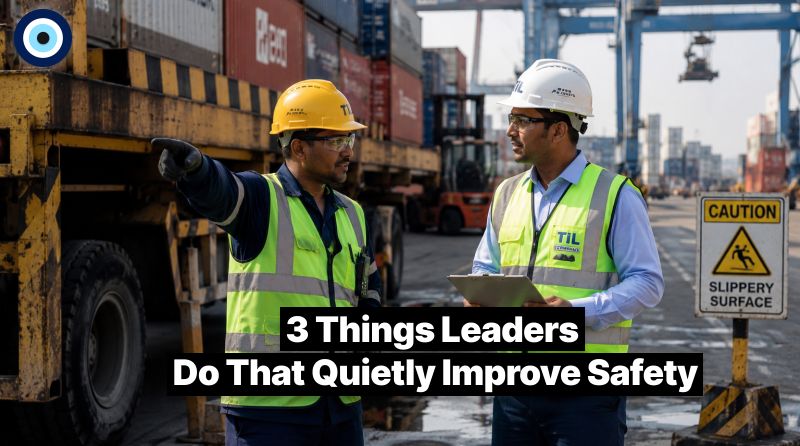
The ones who walk the floor on a calm Tuesday morning, when there's nothing to investigate and no one to interrogate, they are teaching the opposite.
That safety lies in the day-to-day… not merely in the post-mortem.
2. Rewarding reporting, not absence.
A team with zero near-misses reported isn't necessarily safer than one with thirty. It's quieter, sure, but is that enough?
The safety leaders with lasting results appreciate the team that speaks up, not only the team that hits zero. They understand the difference between "nothing happened" and "nothing was reported," and help their teams imbibe that understanding.
3. Publicly backing individuals.
Countless terminals will claim a stop-work culture. I think too few practice it.
Those that do are led by people who understand the value of work stopping, schedules slipping, costs climbing.
These are the safety leaders who choose, consciously, to thank the person who called an incident. In front of everyone. That single moment of recognition can teach a team more about safety culture than a dozen training videos.
Three things. Non-expensive. Not complicated. All fundamental.
I have watched these three behaviours transform what dashboards measure, because culture and data move together. And that’s why we build Qavach the way we do- to enable meaningful safety leadership.
Which of these does your leadership team embrace?